Are Word Searches Good for Your Brain?
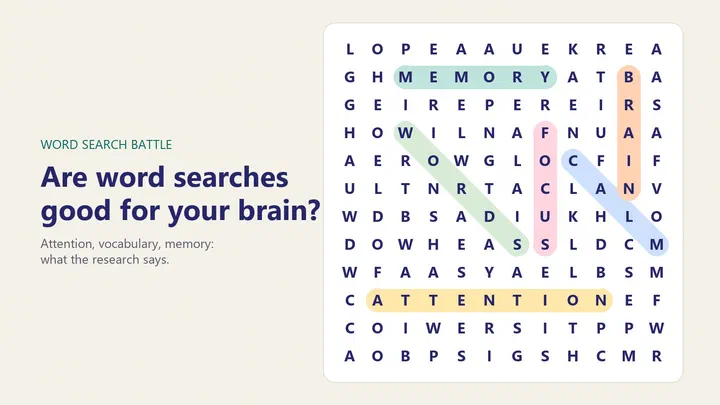
Short answer: yes, in a modest way. A word search exercises attention, visual scanning and vocabulary, it is calming, and adults who do word puzzles regularly tend to score better on thinking tests as they age. It will not make you smarter in general, and it will not prevent dementia. Here is what is actually known.
What a word search trains
A word search looks like a vocabulary exercise. Mostly it is an attention exercise.
- Sustained attention. You hold a target word in mind and keep scanning until you find it, ignoring hundreds of letters that do not matter. Most of a puzzle is spent doing this.
- Visual scanning and pattern recognition. Reading a grid in eight directions, spotting a rare letter or a double letter, recognizing the first two letters of a word: these are the same skills as proofreading and finding a name in a list.
- Working memory. Holding three or four target words at once while you sweep the grid is a working-memory load, and a bigger one on a hard 15 × 15 puzzle than on an easy one.
- Vocabulary and spelling. Every word is spelled out letter by letter as you trace it, and themed puzzles put twenty related words in front of you at once, some of them new.
What the studies show
Regular word puzzles go with better thinking in later life. The PROTECT study, run by the University of Exeter and King’s College London, looked at more than 19,000 adults aged 50 to 93. Those who did word puzzles regularly performed better on tests of attention, reasoning and memory, and the most frequent puzzlers scored like people up to ten years younger on some measures (summary on ScienceDaily). This is an association. People who are already sharp may simply do more puzzles. The authors are careful to say the study does not show cause.
Training on a task mostly improves that task. A large 2010 trial published in Nature had more than 11,000 people practice computerized brain-training games for six weeks. They got better at the games and showed little improvement on general reasoning and memory tests (Owen and colleagues, Nature). The lesson for word searches is the same: you get better at word searches, and at the attention and scanning they use, and you should not expect much beyond that.
Absorbing tasks lower stress. A word search demands full attention and nothing else, which is what makes it a good break. That is a reason to do one at the end of a day, not a treatment for anything.
What word searches do not do
They do not prevent Alzheimer’s disease or other dementias. Nothing that fits on a sheet of paper does. The things with real evidence behind them for brain health are exercise, sleep, blood pressure, hearing, and staying socially active. A puzzle habit sits alongside those, as something enjoyable that keeps you reading and thinking, and that is a fair claim on its own.
How to get more out of a daily puzzle
- Make it harder over time. Move from the easy 10 × 10 sheet to the hard 15 × 15 one, or time yourself and try to beat yesterday.
- Change the topic. A new theme brings new words. There are more than 140 to print or play.
- Play against someone. A real-time word search battle against a friend adds speed and a bit of pressure, which is where the attention training happens.
- Do some on paper. Circling with a pen uses hand and eye together and takes the screen out of the evening.
- Keep it daily. There is a new puzzle on the home page every day, matched to the day’s occasion, and a short habit beats an occasional long session.
Related: benefits of word searches for seniors, benefits for kids and word search tips and tricks.